
You don't need much to start
The internet wants to sell you a dungeon. Every "essential BDSM starter kit" blog post links to a cart full of products you don't need, written by someone with an affiliate code. The reality is simpler. Most people getting into BDSM toys for beginners need three or four items, maybe less, and at least one of them is already in your house.
The first question isn't "what should I buy?" It's "what am I actually interested in?"
If you haven't figured that part out yet, start with our beginner's guide to BDSM. It walks through the different categories of play and helps you identify where your curiosity actually lives. There's no point in buying a flogger if what excites you is blindfolds and whispered commands. There's no reason to invest in restraints if what you're drawn to is power exchange and rules.
Once you know the general direction, you can buy with purpose instead of guessing. Below is a category-by-category breakdown of what's worth getting, what's a waste, and where your money makes the biggest difference.
Sensation play toys: the best place to start
If you're completely new and don't know where to begin, sensation play is the lowest-risk, highest-reward entry point. Nothing here requires technical skill. Nothing is going to leave a mark. And the range of intensity goes from barely-there to surprisingly intense, all with simple, cheap tools.
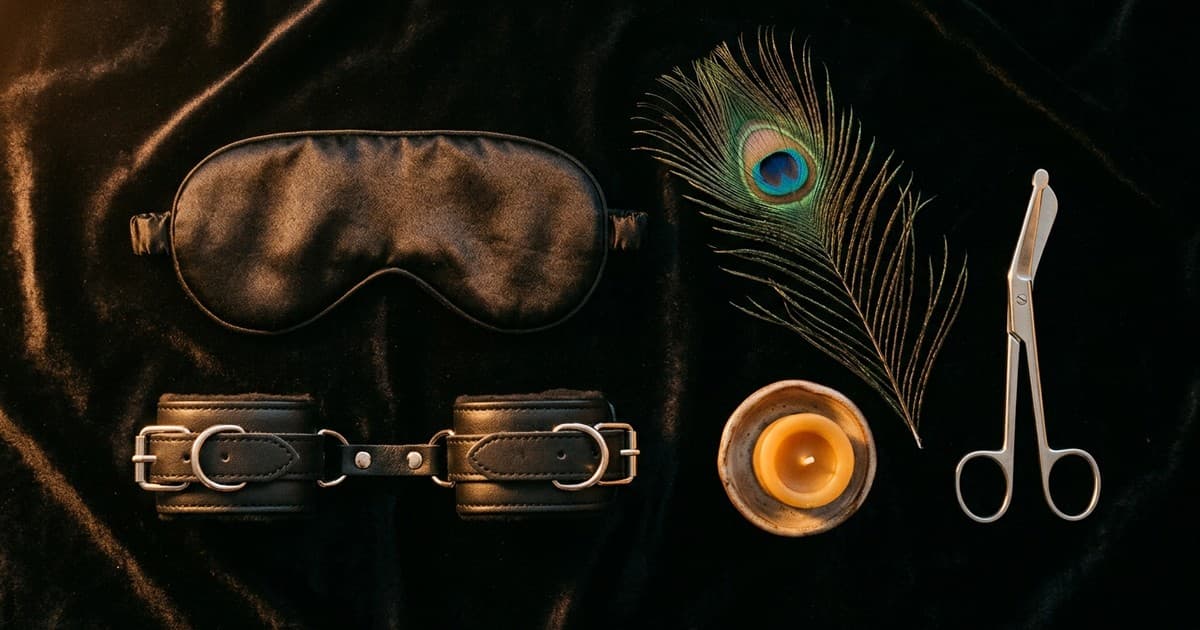
A blindfold. This is the single most effective beginner toy and you probably already own one. A sleep mask from the drugstore works perfectly. Taking away sight amplifies every other sense. A fingertip across the collarbone goes from pleasant to electric when the person can't see it coming. Five dollars. Maybe ten if you want something in silk.
A feather tickler or Wartenberg wheel. These sit on opposite ends of the sensation spectrum. The feather is soft, teasing, almost frustrating in how light it is. The Wartenberg wheel (that little spiky pinwheel doctors used to use for nerve testing) is sharp and prickly without actually cutting skin. Together they give you a full range to work with. Run the feather down someone's stomach, then follow the same path with the wheel. The contrast does the work for you.
Massage candles. These burn at a lower temperature than regular candles, which makes them safe for pouring on skin. The wax melts into warm massage oil. It looks dramatic, it feels good, and the slight sting of heat on bare skin is a gateway into temperature play without any real risk. Stay away from regular candles, especially anything with fragrance or color additives. Massage candles exist specifically for this. Spend the $15.
Ice. Free. Already in your freezer. Run an ice cube slowly along someone's inner thigh, their neck, their lower back. Follow it with your warm breath. Pair it with a blindfold and you have a full scene with zero shopping required.
Our sensation play guide goes deeper into techniques and safety considerations for each of these.
Restraint toys
Restraint is where most beginners' imaginations go first, and it's where buying the right thing actually matters for safety.
Under-bed restraint system. This is the most practical first restraint purchase. Four straps that slide under your mattress with cuffs on each end. Adjustable, no knots required, works with any bed. Typically $20 to $30. The person restrained can pull against them without the setup shifting, and removing them takes seconds. No headboard required, no rope knowledge needed, no hardware to install.
Velcro cuffs. Quick-release by design. You pull the velcro and they open instantly. They're not as secure as locking cuffs, but that's the point for beginners. The person wearing them can get out fast if they need to. The person who put them on can remove them fast if something goes wrong. Security is a feature for experienced players. Escape-ability is a feature for new ones.
Why you should avoid cheap metal handcuffs. The novelty handcuffs from the costume shop look fun until someone's wrist swells slightly and the cheap ratchet mechanism won't release. Or the key bends. Or falls between the mattress and the wall while someone is panicking. Metal cuffs with a small key and no quick-release backup are a genuine safety hazard. If you want metal cuffs eventually, buy quality ones with a double-lock mechanism and a safety release. That's a later purchase. Start with velcro.
Bandage scissors. This isn't optional. If you're using any kind of restraint, rope, fabric, strap, anything, you need a way to cut someone free in an emergency. Bandage scissors have a blunt tip that slides against skin without cutting it, designed specifically for cutting material off a person's body. Five dollars at any pharmacy. Put them on the nightstand before you start. Every time.
For more on restraint techniques and safety, check out our bondage guide.
Impact play toys
Impact play covers everything from a light spank to a full paddling scene. When you're looking at BDSM toys for beginners in this category, the goal is control. You want tools that let you predict exactly how much force you're delivering and where it's landing.
Your hand. Free. Already attached to you. And it's the best impact toy for beginners because you get direct feedback. You feel what you're delivering. You can gauge the sting, the force, the reaction in real time. You can start feather-light and build gradually. Most people's entire impact play journey starts and ends here for the first several months, and there's nothing wrong with that.
A leather paddle. Paddles are predictable. Flat surface, defined striking area, consistent force distribution. A basic leather paddle gives a solid thud without wrapping around the body the way a strap can. The sensation is more "thump" than "sting," which most beginners find easier to receive. Pick one that feels balanced in your hand. You don't need anything fancy.
A flogger with soft falls. Floggers look intimidating but a soft suede or leather flogger with wide, flat falls is one of the more forgiving impact toys. The sensation is thuddy and diffuse rather than sharp and focused. It covers a wider area, which means there's less chance of accidentally catching a spot you didn't intend to. Swing it at your own forearm first. If it feels warm and heavy without being sharp, you've got the right one.
What to skip. Riding crops deliver a precise, intense sting that's harder to control than it looks. Canes are thin and focused and can cause damage fast in untrained hands. Single-tail whips are essentially expert-level tools that take months of practice on a pillow before they should touch a person. These aren't bad toys. They're just not first toys. Put them on the list for later, once your accuracy and force control are consistent.
Our guides on impact play and spanking cover technique, positioning, and safe zones in detail.
Power exchange essentials
Not everything in BDSM requires a physical toy. Power exchange dynamics often run on symbolic objects and structured practices more than equipment. If your interest leans toward dominance and submission, your first "purchases" might not be purchases at all.
A day collar or symbolic jewelry. This doesn't need to be an obvious BDSM collar. A simple necklace, bracelet, or ring that carries meaning between you and your partner works perfectly. It's a physical reminder of the dynamic that the person wears in everyday life. Some couples use an anklet. Some use a specific hair tie. The object matters less than the intention behind it. Our post on BDSM collar meaning covers the different types and what they traditionally represent.
A journal or notebook. For rules, reflections, assignments, punishments, rewards, and processing. Submissives often find that writing about their experiences helps them understand their own responses. Dominants find that keeping notes on what worked and what didn't makes them better at reading their partner over time. A $3 notebook does this job as well as anything.
A timer. For corner time, position holding, endurance tasks, daily rituals. A phone timer works, but some couples prefer a physical kitchen timer because it removes the phone from the equation. Setting a timer for five minutes of kneeling in position sounds simple. Doing it feels like much more.
If you're building a rule-based dynamic, our post on BDSM rules examples has 30 specific rules across different dynamic styles to give you a starting point.
Safety gear: non-negotiable
This section isn't about play preferences. It's about what should be within arm's reach during any scene, regardless of what kind of play you're doing.
Bandage scissors. Mentioned above in the restraint section, but worth repeating because this is the single most important piece of safety equipment. If you buy nothing else on this entire list, buy bandage scissors. They cut through rope, fabric, velcro straps, zip ties, anything that might be around a person's body that needs to come off fast. Blunt tip means you won't cut skin while removing material. Keep them on the nightstand. Not in a drawer. Not in the bathroom. Right there.
A basic first aid kit. Adhesive bandages, antiseptic wipes, an instant cold pack, medical tape, and antibiotic ointment. Impact play can break skin occasionally even when you're being careful. Rope can leave friction burns. Wax can irritate sensitive skin. Having basic supplies means you handle small issues immediately instead of interrupting aftercare to hunt through cabinets.
Lube. Compatible with your toy materials. Silicone lube degrades silicone toys. Water-based works with everything but dries out faster. If you're using any insertable toys or any play that involves sensitive areas, lube isn't a luxury. It's a safety item that prevents injury. Check the label. Match it to what you're using.
Non-verbal safeword signals. Not a purchase, but a piece of safety gear you set up before playing. If someone is gagged, blindfolded, or deep in a headspace where words don't come easily, they need another way to stop the scene. A ball or set of keys held in the hand. When they drop it, the scene stops. A bell within reach. A specific pattern of taps on the bed or their partner's body. Agree on it before you start. Test it before you need it.
Our health and safety guide and safewords guide cover these topics in full.
What to skip as a beginner
Knowing what not to buy saves you money and keeps you safe. Here's what to leave on the shelf until you've got more experience.
Anything requiring technical training. Suspension gear, electrostimulation devices, needle play supplies, single-tail whips, breath play equipment. These are not inherently dangerous in skilled hands. But they're genuinely risky in untrained ones. Every one of these has a learning curve that involves studying technique, practicing on non-human surfaces, and ideally learning from someone experienced in person. There's no shortcut, and buying the gear doesn't give you the skill.
Anything without a quick-release mechanism. If you can't remove it in under five seconds during a panic, it doesn't belong in a beginner's toy bag. This applies to cuffs, collars, restraint systems, and anything worn during play. Quick-release isn't a sign of being casual about your kink. It's a sign of taking safety seriously.
"Fifty Shades starter kits." The branded kits sold on the back of the movie franchise are almost universally cheap materials, poor construction, and questionable safety design. They're priced for impulse buyers, not practitioners. If you want a paddle, buy a proper paddle from a company that makes them for people who actually use them. Skip the branded box set.
Expensive gear before you know your preferences. A $200 custom leather flogger is a beautiful thing. It's also a waste of money if you use it twice and realize you're not that into impact play. The first few months of exploring BDSM toys for beginners should be about cheap experiments and borrowed household items. Invest in quality once you know what you'll actually use. Not before.
Where to buy
A few general principles that apply regardless of where you shop.
Material safety comes first. For anything touching skin, look for body-safe silicone, stainless steel, or real leather. Cheap plastic, jelly rubber, and mystery materials with no labeling can contain phthalates and other chemicals you don't want on sensitive areas. If the listing doesn't specify the material, that's a reason to pass.
Read reviews from actual practitioners. Not just the five-star reviews. Look for detailed reviews from people who describe how they used the item, how it held up, and what the sensation was like. A paddle with 500 generic reviews is less useful than one with 50 reviews from people who clearly know what they're talking about.
Reputable retailers over random marketplace sellers. Shops that specialize in adult products or BDSM gear specifically tend to curate their inventory for quality and safety. Generic marketplaces often mix quality items with cheap knockoffs, and it's hard to tell the difference from a product photo.
Body-safe doesn't mean expensive. You can find quality silicone items, stainless steel implements, and real leather goods at reasonable prices. The sweet spot for BDSM toys for beginners is usually the mid-range. Not the cheapest option, not the premium tier. Functional, safe, and durable enough to last while you figure out what you like.
Start with what interests you
The best approach to buying your first toys is simple. Pick two or three items from the categories that actually interest you. Not the categories you think you should be interested in. Not the ones that look impressive. The ones that made something in you light up when you read about them.
Then plan a scene around those items. Our scene planning guide walks through the full process of negotiating, setting up, running, and closing a scene with your partner. Having a plan turns a handful of purchases into an actual experience instead of a drawer of things you bought and never used.
If you're the submissive entering your first scenes, our first-time sub checklist covers what to prepare, what to ask for, and what to expect.
And if you're ready to put the whole picture together, defining roles, boundaries, limits, safewords, and expectations in one document, our contract builder lets you build a custom agreement with your partner. Take the BDSM quiz to figure out where you fall on the spectrum, or explore the full kink list to see what's out there before you spend a dollar.
The toys are just tools. What you do with them, and who you do it with, is the part that matters.