
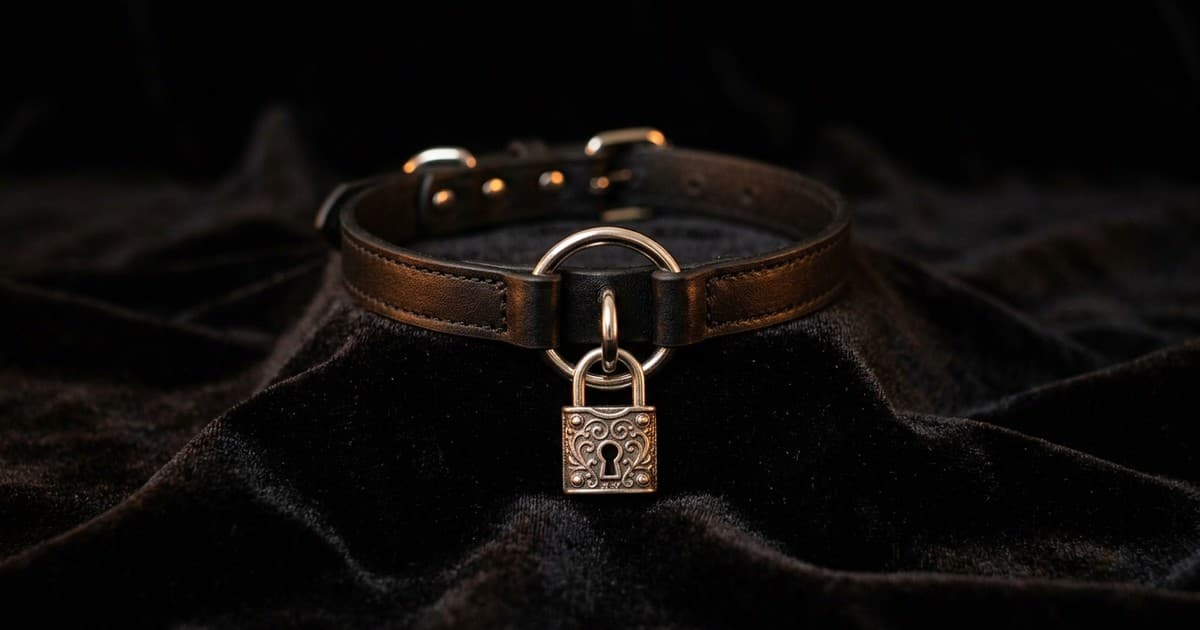
What a BDSM collar actually means
A collar is not jewelry. It can look like jewelry, and plenty of collars double as beautiful accessories, but the object itself is secondary to what it represents. The bdsm collar meaning comes from the relationship behind it: a negotiated power exchange between two people who have chosen their roles deliberately.
When a dominant places a collar on a submissive, they're both making a statement. The dominant is saying "I accept responsibility for guiding this dynamic." The submissive is saying "I trust you with my vulnerability." The collar is the physical reminder of that exchange. It sits against the skin. It has weight. Every time the submissive touches it or catches their reflection, they feel the dynamic's presence.
But collars don't all carry the same weight, and that's where things get interesting.
Some people treat collaring with the same seriousness as a marriage proposal. They plan ceremonies, write vows, invite witnesses. For them, a collar is a life commitment. Others use collars more casually, as a playful element during scenes or as an early-stage signal that they're exploring a dynamic. Both approaches are completely valid. The bdsm collar meaning in your relationship is whatever you and your partner decide it is.
What makes collaring different from, say, buying matching bracelets is the negotiation behind it. A collar comes with understood expectations, responsibilities, and boundaries. It references something specific about how two people relate to each other. Without that foundation, it's just a necklace.
If you're new to power exchange dynamics and trying to understand where collaring fits, our beginner's guide to BDSM covers the foundational concepts first.
Types of BDSM collars (by stage)
The kink community recognizes several distinct collar types, each tied to a different stage of a dynamic. Think of them as chapters in a relationship, not a rigid hierarchy everyone must follow in order.
Collar of consideration
This is the exploration phase. A collar of consideration signals that two people are testing whether their dynamic works. The dominant and submissive are getting to know each other's rhythms, boundaries, and compatibility. Nothing is permanent yet. Everything is a question.
Consideration collars tend to be simple and discreet. Sometimes it's not a collar at all. A bracelet, an anklet, a specific ring. The point isn't the object's appearance. It's the agreement: "We're figuring this out together, and during that process, we belong to each other in this particular way."
In community settings, a consideration collar also tells other dominants that the submissive is spoken for and not open to approaches. That social signaling matters at events, munches, and dungeons where people are actively seeking connections.
The commitment level is low. The curiosity level is high. If the dynamic doesn't work out, the consideration collar comes off and both people move on without the emotional weight of breaking a major commitment.
Training collar
The dynamic has been established. Both partners have decided this works and they want to build it further. A training collar marks the shift from exploration into active learning.
During this phase, the submissive is learning the dominant's specific preferences, rules, and protocols. How do they want to be addressed? What are the daily expectations? What does service look like in this particular relationship? The dominant is simultaneously learning the submissive's responses, limits, and growth edges.
A training collar often replaces the consideration collar in a small, sometimes private exchange. It signals progression. The "maybe" has become a "yes, and here's how we're building this."
For couples who use structured rules, this is the phase where those get tested and refined. Our list of 30 BDSM rules examples is a useful reference for this stage, especially if you're trying to figure out which rules actually fit your dynamic versus which ones sound good on paper but don't work in practice.
Formal collar (permanent collar)
This is the commitment collar. For many people in the kink community, receiving or giving a formal collar carries the same emotional and relational weight as a wedding ring. It says: this dynamic is not a phase, not an experiment, not something we're trying on. It's a core part of who we are together.
Formal collars are often the most meaningful piece of kink-related property a submissive owns. They tend to be more carefully chosen, sometimes custom-made, and designed to reflect the specific relationship they represent. A locked collar that requires a key held by the dominant. A specific metal or material that carries personal significance. An engraving on the inside that only the wearer sees.
The exchange of a formal collar usually happens in a ceremony, whether private or witnessed. Many couples write vows. Some invite their kink community. The dominant offers the collar. The submissive accepts. And from that point forward, the collar represents a bond that both people intend to maintain long-term.
We have an entire collaring ceremony guide that walks through how to plan one, what to include, and how ceremonies differ based on the type of dynamic.
Day collar
A day collar solves a specific problem: how do you carry the symbol of your dynamic into the vanilla world without drawing unwanted attention?
The answer is a collar that doesn't look like a collar. A delicate chain necklace with a small lock charm. A sleek choker that passes as a fashion accessory. A bracelet or anklet with a discreet symbol only the wearer and their partner recognize. Some day collars use a specific gemstone or material that holds private meaning.
Day collars let the submissive feel the dynamic's presence at work, at the grocery store, at family dinners. The collar is always there, always touching the skin, always reminding. But nobody else knows. The barista sees a pretty necklace. The wearer feels their dominant's claim. That tension between the public and private meaning is part of what makes day collars so popular.
Many collared submissives have both a formal collar for private use and a day collar for public life. The two aren't in competition. They serve different functions within the same commitment.
Play collar
A play collar has no ongoing relationship significance. It goes on when a scene starts and comes off when the scene ends. That's it.
Play collars are common in casual kink arrangements, at play parties, and between partners who enjoy collar-related dynamics during scenes but don't attach the weight of an ongoing commitment to the act. Someone might have a heavy leather collar for impact play scenes, a posture collar for discipline scenarios, and a decorative collar for more sensual sessions.
Some people collect play collars the way others collect toys. Different collars for different moods, different scenes, different partners. There's no contradiction between treating formal collaring as sacred and having a drawer full of play collars. The bdsm collar meaning in each case is defined by the context and the agreement.
Collaring ceremonies
When a collar carries real relational weight, the moment of giving and receiving often gets formalized into a ceremony. These range from completely private to community-wide events, and there's no single template everyone follows.
What they can look like
At the simple end: two people in their living room. The dominant produces the collar. They talk about what it means. The submissive accepts it. It goes on. Maybe there's a candle lit. Maybe they've written something to read to each other. Maybe they just look at each other and know.
At the more elaborate end: invited guests, a planned ritual space, formal attire (or none), vows exchanged before witnesses, music, symbolism woven into every element. Some ceremonies incorporate specific kink community traditions from Old Guard leather culture. Others invent their own rituals from scratch.
Most collaring ceremonies fall somewhere between those extremes.
Common elements
Regardless of scale, certain elements show up again and again in collaring ceremonies:
Vows or declarations. The dominant states what they commit to providing. The submissive states what they offer in return. These are usually specific to the relationship, not generic scripts pulled from the internet. The best vows name real things about how the dynamic works.
The physical exchange. The dominant places the collar on the submissive. This is the moment. Some submissives kneel. Others stand. Some couples build in a moment of eye contact before the collar goes on, a final silent confirmation.
Witnesses. Not always, but often. Trusted friends, community members, or a mentor couple who knows the dynamic well. Witnesses add social weight and give the couple people who can hold them accountable to their commitments.
A contract. This is where the symbolic and the practical meet. Many couples sign or update a BDSM contract as part of the collaring ceremony, documenting the specific agreements, rules, and boundaries that the collar represents. It turns the emotional moment into something both partners can reference later.
For a complete walkthrough of planning a ceremony, read our collaring ceremony guide. It covers scope, vows, format, and what comes after the collar goes on.
Choosing a collar
The "right" collar depends on how it will be used, who's wearing it, and what the dynamic needs. Here's what to think through.
Material
Leather is the classic. It's warm against skin, ages beautifully, and carries strong associations with kink culture. Leather collars range from thin and subtle to thick and unmistakable.
Metal (stainless steel, titanium, silver, gold) is popular for day collars and permanent wear. Metal collars and collar-style necklaces can be extremely discreet or very obviously a collar, depending on the design. Some locking metal collars require a specific tool to remove, which adds to the symbolism.
Chain offers flexibility and visual impact. Fine chain for day collars, heavier chain for play. Chains can incorporate lock-and-key elements easily.
Fabric and paracord provide comfort and affordability. Good for training-phase collars or dynamics that are still finding their aesthetic.
Silicone is hypoallergenic, easy to clean, and practically indestructible. It lacks the visual romance of leather or metal, but it's deeply practical for submissives with skin sensitivities or physically demanding lifestyles.
Comfort
If the collar will be worn daily, comfort is everything. Consider weight (a heavy metal collar gets exhausting after eight hours), skin sensitivity (nickel allergies are common), width (wide collars restrict neck movement), and how the collar interacts with clothing (does it catch on shirt collars or lay flat underneath?).
A collar that looks stunning but causes irritation after an hour is not a collar that will get worn. Try before you commit to a permanent piece.
Discretion
Does the submissive work in an environment where a visible collar would cause problems? Are there family situations where questions would be unwelcome? If discretion matters, the collar needs to read as normal jewelry to anyone who doesn't know what they're looking at.
Popular discreet options include: thin chain necklaces with a small meaningful pendant, tennis bracelets with a locking clasp, anklets that stay hidden under pants, and rings on specific fingers. The kink community has gotten creative with this, and the options keep expanding.
Budget
You can find collars at every price point. Simple leather collars start around $15-20. Etsy has hundreds of options in the $30-80 range. Custom metalwork, engraved locking collars, and precious metals can run into hundreds or thousands.
The price tag does not determine the bdsm collar meaning. A $20 collar given with genuine intention carries more weight than a $500 collar given on impulse. Spend what makes sense for your situation and invest the real energy into the relationship the collar represents.
Safety
This one is non-negotiable. Every collar must be removable in an emergency.
For scene collars: quick-release mechanisms, breakaway clasps, or designs that can be cut with safety shears. A collar that cannot be removed quickly during a scene is a safety hazard, full stop. If breathing becomes restricted or a medical situation arises, you need that collar off in seconds.
For daily wear collars: a clasp or mechanism the wearer can operate independently. Even in dynamics where the dominant "controls" the collar, the submissive must always have the physical ability to remove it if needed. Any dominant who insists otherwise is waving a red flag.
For locking collars: the key should always be accessible. Some couples keep a spare key in a known location. Others use locks that can be cut with bolt cutters if the key is lost. Plan for the worst case before it happens.
Removing a collar
Collars come off. Dynamics end, evolve, or transform. Talking about decollaring isn't pessimistic. It's realistic, and it's part of understanding what collaring means in full.
What it signifies
When a collar is removed permanently, it marks the end of the dynamic the collar represented. For couples who treated the collar as equivalent to a wedding ring, decollaring carries similar emotional weight to divorce. It's significant. It deserves to be handled with the same care and communication that went into putting the collar on in the first place.
How it happens
Decollaring can be mutual. The dynamic has run its course. Both people recognize it. They sit down, talk about it, and the collar comes off. Some couples create a small ritual around this, a quiet acknowledgment of what the dynamic was and gratitude for what it gave them.
It can also be unilateral. One person decides the dynamic no longer serves them. In healthy situations, this is followed by a conversation, an explanation, and a respectful separation. The collar returns to the dominant, or the submissive keeps it, or it gets put away. Different couples handle the physical object differently.
When removal becomes a red flag
A dominant who threatens to remove the collar as punishment or who uses the collar's presence as leverage during arguments is misusing the symbol. "Behave or I'll take your collar" is not a protocol. It's manipulation. Collaring is supposed to represent trust, safety, and commitment. Weaponizing it undermines all three.
Similarly, a dominant who refuses to remove a collar when the submissive asks for it to come off is violating consent. The collar is a symbol of an agreement. If one person wants out of the agreement, the collar comes off. Period.
For more on recognizing unhealthy patterns in power exchange dynamics, read our red flags checklist.
The collar means what you decide it means
There's no central authority that dictates bdsm collar meaning. No certification board. No standardized rulebook. The kink community has traditions, and those traditions carry wisdom worth learning. But ultimately, the collar on your neck or the one you place on your partner means exactly what the two of you have negotiated it to mean.
Maybe your collar represents a lifelong commitment formalized in a ceremony with fifty witnesses. Maybe it's a simple bracelet you bought together on a Tuesday because it felt right. Maybe you've been in the dynamic for years and haven't collared at all because the symbol doesn't speak to you. All of those are valid.
What matters is the conversation. The negotiation. The ongoing check-ins about what the collar still represents and whether the dynamic it symbolizes is still working for both people.
If you're ready to document what your collar means, what rules it comes with, what the expectations are on both sides, our contract builder is designed exactly for this. Put the beautiful symbolism on paper so it has structure to support it.
Not sure where you fall in the power exchange spectrum? Our BDSM quiz can help you explore your inclinations. And if you want to map out your interests in more detail, the kink list gives you a structured way to do that with a partner.
The collar is a symbol. The relationship is the thing. Build the thing well, and the symbol will carry all the meaning it needs to.