
Why planning matters
The scenes that go well aren't the ones where someone just went for it. They're the ones where both people knew what was coming, had a say in how it would go, and felt safe enough to actually let go.
BDSM scene planning gets a bad reputation. People think it kills the mood. That talking through every detail ahead of time makes the whole thing feel clinical, like scheduling a doctor's appointment instead of doing something hot.
It's the opposite. When you know your partner's limits, when you've set up the space, when you have safewords locked in and aftercare supplies ready, you're not thinking about logistics during the scene. You're present. You're in it. The planning is what makes the intensity possible.
This guide walks through every step of setting up your first scene, from the conversation that happens days before to the debrief that happens after. If you're brand new, start with the beginner's guide and come back here when you're ready to put something together.
Step 1: Talk about what you both want
This conversation shouldn't happen five minutes before you start. Have it a day or two before, somewhere neutral, when nobody's in the headspace yet. A couch, a coffee shop, a phone call. Somewhere you can both think clearly and speak honestly.
Start with the basics:
What kind of scene are you going for? Playful and teasing? Intense and serious? Slow and sensual? The mood you're aiming for shapes everything else: what activities you pick, how you talk to each other, how much intensity to build in.
Who's in what role? If you're new to power dynamics, be explicit about this. Who's dominant, who's submissive, and what does that mean for both of you in practice? "Dominant" doesn't mean one thing to everyone. Neither does "submissive." Talk about what each role looks like for this specific scene.
What are you each hoping to get out of it? Connection? Adrenaline? A sense of surrender? A chance to feel in control? You don't need matching answers, but you should know each other's answers.
The negotiation guide goes deep on how to have this conversation well. Read it before you sit down together. The short version: listen more than you talk, and treat everything your partner says as useful information rather than something to negotiate away.
Step 2: Set your boundaries
This is not optional. Every scene needs boundaries, and they need to be set before anyone's pulse is elevated.
Hard limits
These are things you will not do. Full stop. No convincing, no "just try it once," no testing the waters. Both of you should name yours out loud and take them seriously. Hard limits don't need explanations. "I don't want that" is the only reason required.
Soft limits
Things you're curious about but not ready for, or things you'd only want under specific conditions. Soft limits can change over time, but they're still limits right now. Don't treat your partner's soft limit as an invitation to push.
Safewords
Pick them. The traffic light system is the standard for a reason: green means good, yellow means slow down or check in, red means stop everything now. Also agree on a non-verbal signal — something that works if someone is gagged, restrained, or too deep in the experience to form words. Dropping a ball, three firm taps, a specific hand signal.
Practice using them before the scene. Seriously. Say them out loud to each other so they don't feel weird in the moment. A safeword that feels awkward to use is a safeword that won't get used.
Health considerations
Anything that affects what you can safely do: injuries, chronic pain, medications, trauma triggers, breathing issues, joint problems. This isn't a mood killer. It's information that keeps someone from getting hurt.
Read the consent guide for more on why boundaries are what makes everything else work.
Step 3: Choose your activities
First scenes should be simple. This is not the time to try everything you've ever been curious about. Pick a few things that excite you both and save the rest for later.
Beginner-friendly combinations
These work well for a first scene because they're adjustable in intensity and easy to stop if needed:
- Blindfold + sensation play — One person can't see, the other uses different textures and temperatures on their skin. Simple, intimate, easy to control intensity.
- Light restraint + verbal commands — Wrist cuffs or held wrists, combined with clear verbal direction. The restraint adds tension without requiring rope skills.
- Sensation play + role assignments — Temperature play (ice, warm wax from a massage candle), light scratching, feathers — with clear dom/sub dynamic guiding the scene.
- Spanking + praise/correction — Light impact with a hand, combined with verbal reinforcement. Easy to read reactions and adjust in real time.
Build a menu, not a script
Don't plan the scene minute by minute. Instead, agree on a set of activities you're both interested in. That's your menu for the evening. This gives the dominant room to read the moment and adjust, and it gives the submissive something to look forward to without knowing exactly when each thing will happen.
The menu approach is central to good bdsm scene planning because it balances structure with spontaneity. You know the boundaries. You know the options. The specifics unfold in the moment.
Step 4: Set up the space
The environment matters more than people realize. A good space lets you both focus on the scene instead of being distracted by a creaky bed, a cold room, or the fear that someone might walk in.
Physical space
Clear the area you'll be using. If it's a bed, strip off the extra pillows and anything breakable on the nightstand. If you're using the floor, put down a thick blanket or mat. If furniture is involved, make sure it's stable. Nothing you're leaning on should wobble or slide.
Lighting
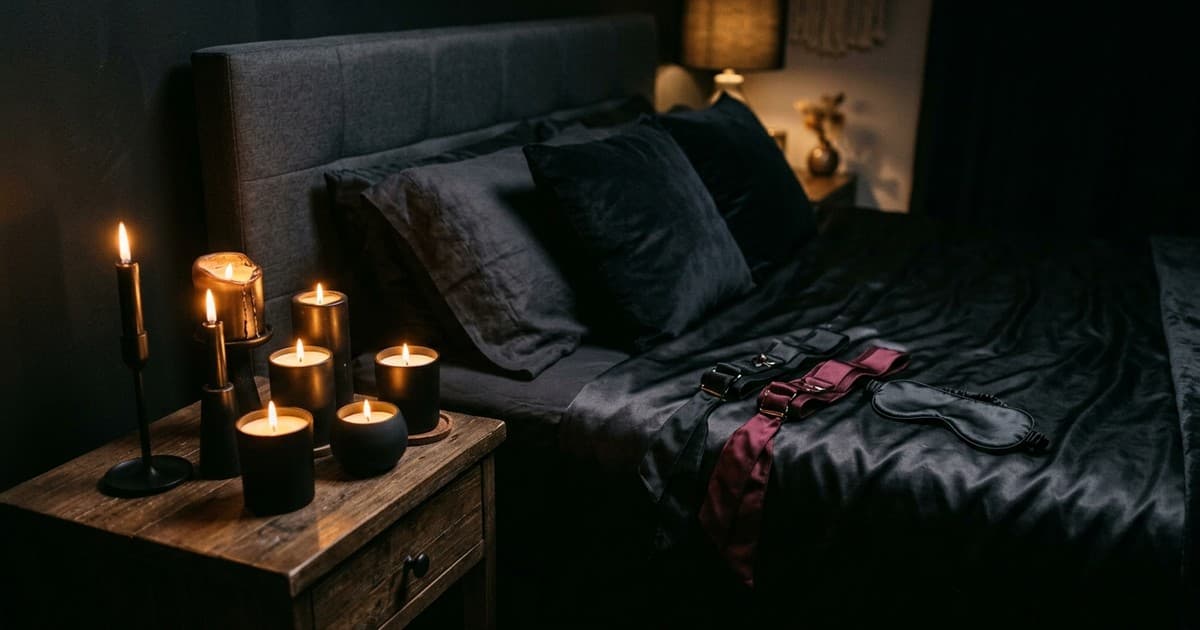
Overhead fluorescents are terrible for this. Dim warm lighting, candles (not near anything flammable or near where someone might knock them over), a lamp with a low-wattage bulb, string lights. Anything that creates a warm, contained atmosphere. Lighting sets the mood faster than anything else.
Temperature
Slightly warmer than normal room temperature. When someone's adrenaline drops or when clothes come off, cold rooms become a problem fast. Have a blanket within reach regardless.
Privacy
Lock the door. Silence your phones or put them face-down in another room (keep one accessible for emergencies, just not where it'll buzz and break the mood). If you have roommates, make sure they know not to knock. If you have kids, make sure they're asleep or out of the house. Interruptions don't just break the scene. They can be disorienting and emotionally jarring for someone in a vulnerable headspace.
The aftercare station
Before the scene starts, set up a spot nearby with everything you'll need afterward: water, snacks, a soft blanket, basic first aid supplies, tissues, whatever comfort items matter to your partner. You don't want to be scrambling for a glass of water when your sub is shaking. Read our aftercare ideas post for specific things to include.
Step 5: Gather your supplies
Get everything out and ready before the scene starts. Nothing breaks a mood like pausing to dig through a drawer looking for something.
Toys and implements
Only bring out what you've agreed to use. Having unexpected items appear mid-scene can create anxiety, especially for someone new. If it's on your menu, it's on the bed. If it's not on your menu, it stays in the drawer.
Safety supplies
This depends on what you're doing, but the basics include:
- Bandage scissors if you're using any kind of rope or bondage tape. These cut through material without cutting skin. They're cheap. Buy a pair.
- A non-verbal safeword signal if you're using any kind of gag.
- Basic first aid: antiseptic wipes, bandages, arnica cream for bruising.
- Lube if anything involves penetration or extended skin contact with toys.
Aftercare supplies
Water bottles, juice or a sugary drink, easy snacks (chocolate, crackers, fruit), a warm blanket, a soft towel. Set these up at your aftercare station before you start.
Emergency access
Keep a phone within reach, not in the scene space itself, but nearby in case something goes wrong and you need to call for help. This is especially important if you're doing anything involving restraint or impact.
Step 6: Run the scene
You've talked, planned, set up the space, and gathered your supplies. Now it's time.
Getting into headspace
Some people can flip a switch. Most can't, especially the first few times. Give yourselves a transition. This might be a specific phrase that signals the scene is starting, a ritual like the submissive kneeling and the dominant placing a collar, or just a few minutes of eye contact and slow breathing together.
Whatever it is, make it intentional. The transition tells both of your nervous systems: we're entering a different space now.
Reading your partner
This is the most important skill in any scene, and it's not something you can plan for entirely. You learn it by paying attention.
Watch their breathing. Watch their body tension. Are they leaning in or pulling away? Listen to the sounds they make. Check their face. Are their hands clenched or relaxed? If something changes suddenly, pause and check in.
If you're the first-time dominant, this is your primary job during the scene. Everything else is secondary to knowing how your partner is doing right now.
Pacing
Don't rush. The most common mistake in first scenes is trying to fit too much in or escalating too quickly. Start lighter than you think you need to. Build slowly. Let anticipation do some of the work.
Think of it like cooking — you can always add more heat, but you can't take it back once you've burned something.
Checking in without breaking the mood
You don't have to pause the scene and have a committee meeting. A simple "color?" gets a green, yellow, or red without shattering the atmosphere. You can weave check-ins into the dynamic: "Tell me how that feels." "Do you want more?" "You're doing so well — should I keep going?"
The goal is information, not interruption. If you've set up the traffic light system, one word tells you everything you need to know.
Ending the scene
Don't just stop. Signal that the scene is winding down. Gradually decrease intensity. Shift your tone of voice. Softer, warmer, slower. If you used a starting ritual, have an ending one. Remove restraints, take off the blindfold, help them sit or lie down comfortably.
The transition out is as important as the transition in. You're bringing each other back.
Step 7: Aftercare and debrief
The scene doesn't end when the last activity is done. It ends when both of you feel okay.
Immediate aftercare
This happens right now, in the first minutes after the scene. Hold each other. Drink water. Eat something. Get under a blanket. Whatever you discussed beforehand, do it. If you're the dominant, don't check your phone or get up to clean. Stay present with your partner.
If you're the first-time submissive, tell your partner what you need. If you're not sure what you need, say that. "I don't know what I need right now, just stay close" is a perfectly good answer.
For specific ideas, check our aftercare ideas post and the aftercare guide.
Debrief within 24 hours
Not in the first five minutes. Wait until you've both come down, slept, eaten, and returned to your baseline. Then talk about it.
Cover these questions:
- What worked? What felt good, what got you excited, what would you do again?
- What didn't work? What was awkward, uncomfortable, or didn't hit the way you expected?
- What surprised you? Good or bad. Sometimes the things you were most worried about end up being the best parts.
- How did you feel afterward? Not just physically. Emotionally. Did anything unexpected come up?
- What would you change next time? This is where bdsm scene planning becomes iterative. Each scene informs the next.
Be honest. Don't protect your partner's ego at the expense of useful information. And don't get defensive if they tell you something didn't work. This conversation is how you get better together.
Start small, keep going
Your first scene won't be perfect. That's not the goal. The goal is a scene where both people feel safe and cared for. Everything else comes with practice.
BDSM scene planning gets easier every time you do it. The conversations get shorter because you know each other better. The setup gets faster because you know what you need. The scenes themselves get better because you're building on real experience, not guesswork.
Start with one scene. Keep it simple. Talk about it after. Then plan the next one.
If you want to formalize what you've agreed to, a written contract puts everything in one place: roles, limits, safewords, aftercare preferences. It's not legally binding, but it's a record of a conversation you both took seriously. And that matters.
Not sure what activities to include? The kink list helps you and your partner compare interests side by side. And the BDSM quiz is a good starting point if either of you is still figuring out your role in the dynamic.