What Is a Pup Play Contract?
A pup play contract is a written agreement between a pup and their handler (or trainer, owner, or alpha) that documents how their dynamic works. It covers roles, boundaries, training, gear, and the day-to-day shape of the relationship. If your pup play involves a pack, the contract also maps out hierarchy and interaction rules between members.
This is not a legal document. A pup play contract is symbolic. It records what you have discussed and agreed to, but consent can be withdrawn at any time by either partner, no matter what the paper says. The value lives in the process of creating it together.
Pup play grew out of the gay leather communities of the 1970s and 1980s, evolving from older styles of dog/slave play into something with its own distinct culture, vocabulary, and identity. Today the pup community spans all genders and orientations, though it remains deeply rooted in queer spaces and leather tradition. A good contract should reflect not just what you do, but the community context your dynamic sits within.
Why Your Handler/Pup Dynamic Needs a Pup Play Contract
Pup play can range from occasional headspace to a deeply integrated part of someone's identity. That range is exactly why writing things down matters.
As your dynamic grows, especially if it starts overlapping with power exchange or protocol-based structures, memory alone stops being reliable. A written agreement forces both partners to get specific about what "handler" actually means, what training looks like, when pup space starts and ends, and what happens when something goes wrong. That specificity builds trust.
There is also a practical benefit for dynamics that involve community spaces. Pup events, leather bars, pack gatherings, and play parties all bring social variables into your dynamic. Your contract can address how you navigate those situations together and what kinds of interaction with other pups are welcome.
What to Include in Your Pup Play Contract
Pup Identity and Persona
Your pup name, breed personality, and typical behaviors. An eager retriever pup plays differently than a stubborn terrier or a protective shepherd. The contract should describe the persona so both partners share the same picture. Some pups also have preferences about pronouns while in pup space, and your contract is the right place to document those.
If your pup identity is part of how you see yourself beyond scenes, rather than just a role you step into, your contract should reflect that distinction. The difference between "I do pup play" and "I am a pup" shapes every other section of the agreement.
Handler Roles and Responsibilities
Define what "handler" means in your specific dynamic. A handler can be a nurturing caretaker, a firm trainer focused on obedience, a dom who incorporates pup play into broader power exchange, or something entirely different. Your pup play contract should spell out what the handler provides: structure, training, praise, correction, care, or any combination.
Handlers have boundaries too, and the negotiation process should give them equal space to name what they need. The handler/pup relationship is not one-directional. If you want to understand how these responsibilities compare to other power dynamics, our dom/sub contract guide covers role definition in detail.
Training Structure and Commands
What commands does the pup respond to? Sit, stay, heel, fetch, roll over? How are new commands introduced, and what does a typical training session look like? Document the training approach so it stays consistent over time.
Include your reward and correction systems. Positive reinforcement (treats, praise, belly rubs, play time) works differently from structured correction (time-outs, loss of privileges, repeated drills). The contract should reflect the training philosophy you both agree on.
Gear and Collar Protocols
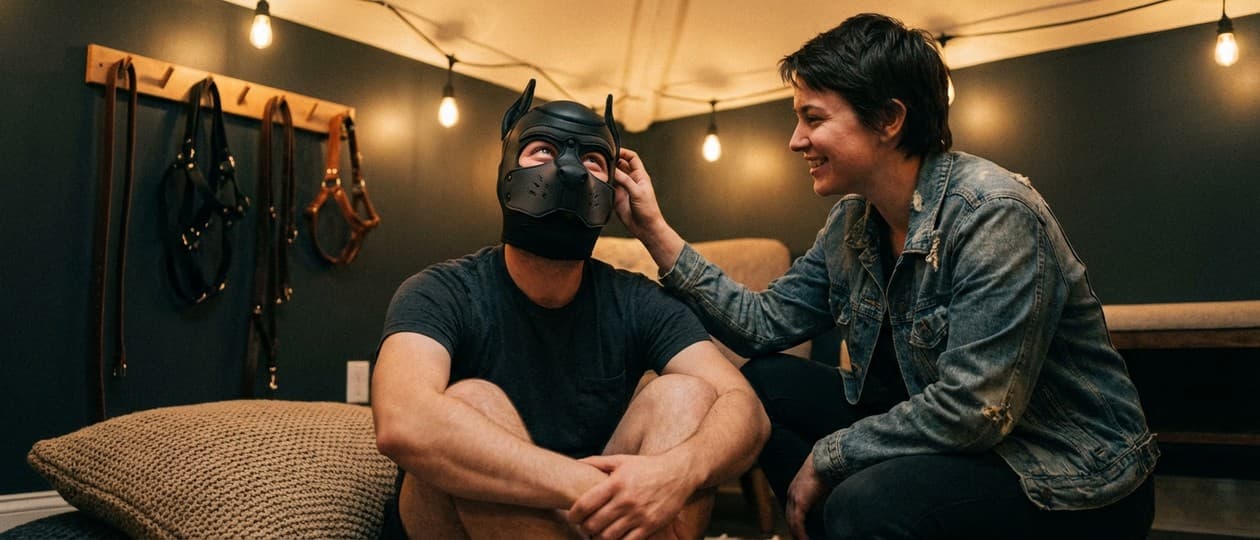
Hoods, mitts, knee pads, collars, leashes, harnesses, tails, neoprene gear. Your contract should cover who owns what, who buys what, and any rules about when specific items are worn.
The collar often carries particular weight in pup play, just as it does in broader BDSM collaring traditions. If your collar has ceremonial significance, your agreement should describe what it represents and the meaning of putting it on or taking it off. Some dynamics use different collars for different contexts: a day collar for public wear, a play collar for scenes, a formal collar for ceremonies.
Pup Space and Pack Dynamics
When and where does pup space happen? At home only? At events? How does the pup enter headspace, and what does the transition back out look like? Your pup play contract should describe how this works, because a handler needs to recognize when their pup is "in" and when something has shifted. Our pup play activity guide covers headspace transitions in more detail.
If your pup plays with other pups or is part of a pack, address the hierarchy (alpha, beta, omega), interaction rules between members, how new pups are introduced, and how the handler manages competing needs. Pack play adds social complexity that solo dynamics do not have, and a thorough pup play contract handles these realities directly.
Safety, Aftercare, and Reviews
Knee pads are not optional for floor time. Hood ventilation matters during extended wear. Mitts restrict hand use, so you need a non-verbal signal ready. The traffic light system (red/yellow/green) works, but add a physical signal like dropping a held object.
Aftercare applies to both pups and handlers. After intense play or deep pup space, the pup may need physical comfort and time to transition back. Handlers experience their own version of drop too. Your contract should describe what each person needs.
Build in a regular review schedule. Monthly for newer dynamics, every three months for established ones. A pup play contract from six months ago may no longer match where either of you is now.
Pup Culture and Your Contract
The pup community has a visible culture with events, competitions, social gatherings, and online spaces. Your pup play contract should address how you engage with that community together. If your dynamic includes rules about outside play, be explicit about what that means at a pup mosh or a leather weekend. The broader pet play guide covers public considerations across species types, but pup events carry their own norms.
For many people, being a pup is an identity, not just an activity. If your partner identifies as a pup outside of scenes, your contract should honor that. The language you use, the rituals you build, and how you talk about the dynamic all reflect how seriously you take that identity.
Build Your Pup Play Contract
Ready to put your dynamic on paper? Our contract guides include pet play sections you can customize for pup-specific needs. Not sure where your interests lie yet? Take our BDSM quiz or build a kink list first.
A pup play contract is a conversation made concrete. It will not be perfect on the first draft, and it does not have to be. What matters is that you and your handler wrote it together, you both agreed, and you plan to revisit it.